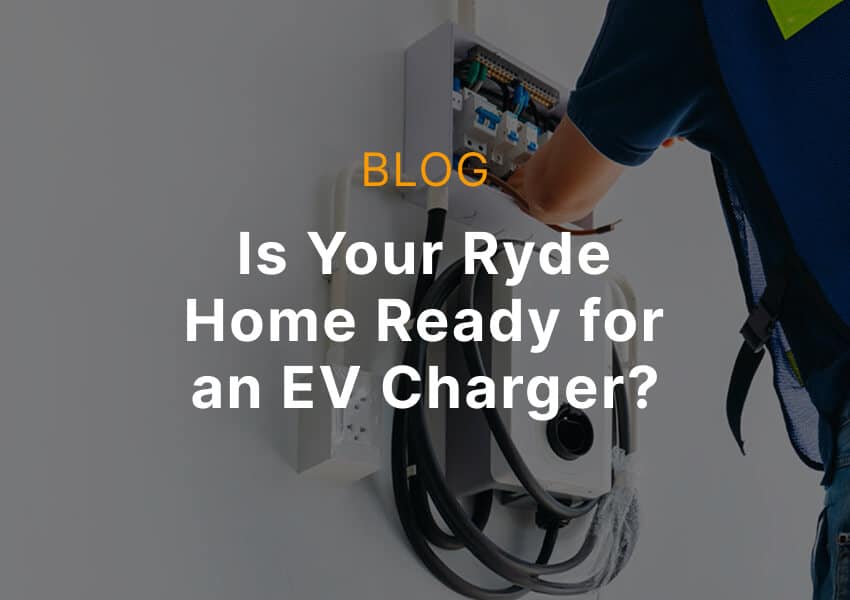
Before an EV charger can be installed in any home, a licensed electrician must assess the switchboard capacity, power supply type, cable run, earthing, and parking access. In Ryde, where much of the housing stock was built in the 1960s and 1970s, many homes require electrical upgrades before installation can proceed safely.
Getting an EV charger installed is not as simple as mounting a box on the wall. The electrical system behind it determines whether it runs safely, reliably, and in compliance with regulations. PowerHub Electrical installs EV chargers across Ryde and surrounding suburbs. This guide covers exactly what gets checked before installation, what upgrades are commonly needed, and how the process works from quote to CCEW.

Why Ryde Homeowners Are Installing EV Chargers Now
Electric vehicle ownership is growing fast across Sydney’s northern suburbs. Ryde, West Ryde, and Meadowbank are home to professionals and families leading EV adoption in the area. Home charging at off-peak rates costs a fraction of public charging, making it the most cost-effective way to run an EV.
According to the NSW Government’s home charger guide, any homeowner with off-street parking and an EV is a candidate for a home charging installation. A Level 2 wallbox charger is the standard hardwired unit, delivering around 7kW and adding approximately 40km of range per hour.
For most Ryde households with a typical daily commute, overnight charging on a 7kW unit provides a full charge by morning.
The challenge specific to Ryde is its housing stock. Much of the suburb was developed in the 1960s and 1970s, with a mix of brick veneer houses, older units, and newer apartment buildings. Older homes in this era often have switchboards and wiring that were not designed for the continuous high-current draw of an EV charger. A thorough pre-installation check is not optional. It is the first step.
What an Electrician Checks Before Installing an EV Charger
EV charger readiness comes down to five areas. Each one must be confirmed before installation proceeds.
Switchboard capacity and available circuit space
A 7kW hardwired charger draws approximately 32 amps on a dedicated circuit. The switchboard must have a spare breaker slot and sufficient total capacity to support that load. Older switchboards in Ryde homes from the 1960s and 1970s often fall short, and if the board still has ceramic fuses, a full switchboard upgrade is required before installation can proceed.
Single-phase versus three-phase power supply
Most Ryde homes run on single-phase power, which comfortably supports a 7kW charger. I check the main switchboard to confirm the supply type. If a three-phase upgrade is needed for faster charging, that work must be carried out by a Level 2 electrician through the network provider.
Cable run distance and sizing
The dedicated circuit cable runs from the switchboard to the charger location. Under AS/NZS 3008.1.1, cable must be sized for the current load and run length. I map the full route before quoting, so a long run through ceiling cavities or conduit is factored in upfront with no surprises on the day.
Earthing and RCD protection
Every EV charger circuit requires a dedicated RCD. Under AS/NZS 3000:2018, Type A is the minimum rating, with Type B recommended for full DC fault protection on some charger brands. I also check the main earthing system, as a corroded or inadequate earth stake must be resolved before any high-current circuit is added.
Parking access and charger placement
The charger must be mounted within a practical cable reach of the vehicle’s charging port. I assess whether the intended location (garage wall, carport post, or driveway) allows for safe, weatherproof installation. Outdoor installations must meet IP-rating requirements for weatherproofing under Australian Standards. The mounting surface, height, and cable management are all confirmed at the site assessment.
More: How to Prepare Your Switchboard for an EV Charger

Why Ryde Homes Often Need Upgrades First
Ryde’s housing stock creates specific pre-installation considerations that do not apply to newer suburbs. Here is what I commonly find across the area.
- Brick veneer homes in Ryde were built in the 1960s and 1970s. Original switchboards in these homes have limited breaker capacity and frequently lack RCD protection. Most need at least a partial switchboard upgrade before an EV circuit can be added.
- Older units and low-rise apartments in West Ryde and Meadowbank. If the charger connects to common property infrastructure, owners corporation approval is required before work can begin. Individual unit switchboards in older blocks are also often undersized for a dedicated EV circuit.
- Post-war homes in Eastwood and Denistone. Homes from the 1950s and 1960s often still have the original switchboard with limited spare capacity. Cable runs can also be longer if the garage or carport sits away from the main board.
- Renovated homes in Marsfield and Macquarie Park. Partial renovations can leave a modern switchboard connected to older sub-circuits that were not upgraded. These need careful load assessment before an EV circuit is added.
- Newer homes and townhouses in Carlingford and West Pennant Hills. Properties built after 2000 generally have modern switchboards with spare capacity and RCD protection already in place. These are typically straightforward single-circuit additions.
What the Installation Process Looks Like
When I install an EV charger for a Ryde home, I follow the same structured process every time. With over a decade of experience working across Epping, Ryde, and surrounding suburbs, this sequence ensures every installation is safe, compliant, and done right the first time.
How I assess and install an EV charger in Ryde
I start with a full site assessment before issuing any quote. I inspect the switchboard, confirm the power supply type, measure the cable run to the proposed charger location, and check the earthing system.
Based on that assessment, I provide a fixed-price quote that covers the charger unit, dedicated circuit, cable run, any switchboard work required, and all compliance documentation. No hidden costs after the fact.
On installation day, I mount the charger, run the dedicated circuit cable, install the RCD protection, and complete all wiring connections at the switchboard. I then test the circuit and commission the charger, including app setup if the unit has smart features.
You receive a Certificate of Compliance for Electrical Work (CCEW) upon completion. This is a legal requirement under NSW electrical regulations and is required by your home insurer. Keep it with your property documents.
More: EV Charger Installation Tips For Parramatta Homes, Units And Townhouses

How to Protect Your Investment After Installation
A well-installed EV charger needs minimal maintenance, but a few habits can protect the system and your vehicle in the long term.
Use off-peak charging schedules
Most smart chargers allow you to set a charging schedule. Programming the charger to run overnight during Ausgrid’s off-peak window (10pm to 7am) significantly reduces your charging costs. A full charge on a standard 60kWh EV at off-peak rates costs a fraction of the daytime equivalent.
Test your safety switch regularly
The RCD protecting your EV charger circuit should be tested every 6 months, along with your other safety switches. Press the test button to confirm it trips instantly. If it does not, contact a licensed electrician. A faulty RCD on a high-current circuit is a serious safety concern.
Check the cable and connector periodically
Inspect the charging cable and connector for signs of wear, cracking, or heat damage every few months. Never use a charger with a damaged cable or connector. If the cable shows any deterioration, have it assessed by a licensed electrician before continuing to use it.
PowerHub Electrical recommends booking a post-installation check every two to three years to confirm that the circuit, connections, and RCD are functioning correctly, particularly for outdoor installations exposed to weather conditions in Ryde and surrounding suburbs.
After PowerHub installed a Tesla charger for his Ryde home, Ray shared this feedback:
“We had Brian and his team install a new Tesla charger for us, and they were absolutely fantastic! From the initial enquiry and quote through to the final installation, the entire process was smooth, efficient, and stress-free — it was all completed in under a week. Brian was incredibly knowledgeable, patient, and always happy to answer our (many!) questions. We couldn’t have asked for a better experience and would highly recommend him to anyone looking for a reliable and professional service!” Ray
That kind of end-to-end experience, from quote to commissioning, is what every EV charger installation should deliver.
Areas We Service
PowerHub Electrical installs EV chargers across Parramatta and the greater western Sydney region, including Ryde, West Ryde, Epping, Carlingford, Eastwood, Beecroft, Dundas Valley, Marsfield, Macquarie Park, Pennant Hills, Denistone, Telopea, West Pennant Hills, Turramurra, and Melrose Park. Whether your home needs a straightforward charger installation or a switchboard upgrade first, our licensed electricians will assess your property and give you a clear plan.
Book Your EV Charger Installation in Ryde
Ready to install a home EV charger? Call PowerHub Electrical on 0400 332 331 or contact us online.
- Same-day service available across Ryde and surrounding suburbs
- $50 off your first service
- 15% pensioner discount on all electrical work
- 24/7 emergency response for urgent faults
- Licensed, insured, and local
We assess your switchboard, quote the full job upfront, and complete the installation with a CCEW issued on the day.
Frequently Asked Questions
Do I need a switchboard upgrade before installing an EV charger in Ryde?
Not always, but it depends on your switchboard’s age and capacity. Homes in Ryde built before the 1990s often need at least a partial upgrade to accommodate a dedicated 32-amp EV circuit. A site assessment confirms whether your existing board can support the installation without any changes.
What does a home EV charger installation cost in Ryde?
A standard hardwired 7kW charger installation in Ryde typically costs between $1,200 and $2,500, covering the charger unit, dedicated circuit, cable run, and CCEW. If a switchboard upgrade is needed, total costs can reach $3,500 or more. PowerHub Electrical provides a fixed-price quote after the site assessment, with no hidden costs.
How long does an EV charger installation take?
A straightforward installation in a home with a suitable switchboard and short cable run takes three to five hours. If a switchboard upgrade or long cable run is needed, the job may take a full day. Most installations are completed in a single visit.
Can I install an EV charger in a Ryde unit or apartment?
Yes, but the process is more involved. If the charger connects to common property electrical infrastructure, you need owners corporation approval before work can begin. Individual unit installations, using each unit’s own meter and distribution board, are more straightforward. PowerHub Electrical can advise on the correct approach for your building.
What charger brands does PowerHub Electrical install?
Brian and the team install all major brands, including Tesla Wall Connector, Wallbox, Zappi, and other leading units. The right charger depends on your vehicle’s maximum AC charging rate and whether you have solar panels. We provide brand-neutral advice based on your specific situation.
Is a CCEW required for an EV charger installation in NSW?
Yes. Under NSW electrical regulations, a licensed electrician must issue a Certificate of Compliance for Electrical Work (CCEW) after every EV charger installation. This is your legal proof of compliant work and is required by your home insurer. Keep it with your property documents.
Can I use solar power to charge my EV at home?
Yes. Smart chargers with solar diversion capability, such as the Zappi, monitor your solar output and direct surplus energy to your EV instead of exporting it to the grid. This can significantly reduce your effective charging cost. Your electrician can advise on which charger models integrate with your existing solar system.
Does NSW offer any rebates or incentives for home EV charger installation?
NSW does not currently offer a direct rebate for individual residential EV charger installations. However, the NSW Home Energy Saver Program provides eligible households with interest-free loans of up to $15,000 for energy upgrades, including EV charger installation. Check your eligibility at energy.nsw.gov.au.