You likely need a switchboard replacement if your board has ceramic fuses, no safety switches, frequent tripping, a burning smell, or is more than 25 years old. Homes across Sydney’s northern suburbs built before the 1980s are the most commonly affected due to ageing electrical infrastructure.
Modern households draw far more power than original boards were designed for, which pushes outdated components beyond their safe operating limits. PowerHub Electrical provides same-day switchboard upgrades and replacements across Epping, Parramatta, and surrounding suburbs. This guide covers every warning sign in detail, what the upgrade process involves, and how much it typically costs.
Why Replacing Your Switchboard Matters More Than Most Homeowners Realise
Your switchboard is the central hub that distributes electricity to every circuit in your home. It controls how power reaches your lights, appliances, hot water system, and air conditioning. When it’s working properly, you don’t think about it. When it’s not, the consequences range from nuisance tripping to house fires.
The problem is that switchboards don’t fail dramatically. They deteriorate slowly over decades, and the warning signs are easy to miss or dismiss.
According to NSW Fair Trading, all electrical installation work in NSW must comply with the Gas and Electricity (Consumer Safety) Regulation 2018 and the AS/NZS 3000 Wiring Rules. A switchboard that was compliant when it was installed 30 or 40 years ago almost certainly falls short of current safety standards.
That doesn’t make it illegal to keep. But it does mean your home lacks the level of protection that modern electrical codes are designed to provide.
Warning Signs Your Switchboard Needs Replacing
The earlier you spot these signs, the sooner you can act before a minor issue becomes a safety hazard. Here’s what to look for when assessing whether your switchboard is due for replacement.
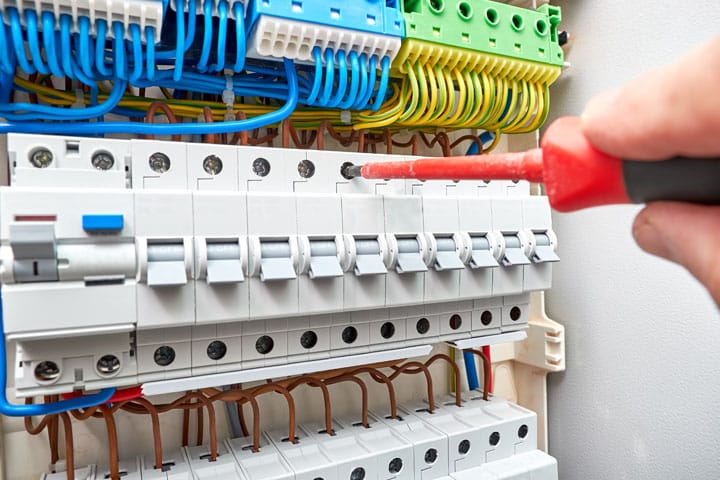
- Ceramic fuses or rewirable fuse wire. If you open your switchboard and see porcelain fuse holders with thin wire threaded through them, your board predates modern safety standards by decades. Ceramic fuse switchboards were standard in Australian homes built before the 1970s, but they offer no protection against earth leakage or electrocution. They also allow homeowners to insert the wrong gauge fuse wire, which creates a direct fire risk.
- No safety switches (RCDs) installed. A safety switch detects earth leakage current and shuts off the circuit in milliseconds to prevent electrocution. The NSW Government’s electrical safety guidance recommends that all homes have safety switches installed and tested twice a year. If your switchboard has no RCDs at all, it’s not just outdated, it’s dangerous.
- Frequent circuit breaker tripping or blown fuses. Occasional tripping is normal. Constant tripping suggests the board can’t handle your home’s electrical load, circuits are overloaded, or there’s a wiring fault the board is struggling to manage. In older Epping and Eastwood homes where original 60-amp boards now support air conditioning, electric cooking, and multiple high-draw appliances, this is one of the most common triggers for a switchboard upgrade.
- Burning smell or discolouration around the board. Scorch marks, a brown or yellow tinge on the switchboard casing, or any burning smell indicates overheating connections or arcing. This is an immediate electrical fire risk. According to Fire and Rescue NSW, electrical faults cause over 350 residential fires in the state every year, and switchboard faults are a significant contributor.
- Flickering lights or inconsistent power. Lights that dim when you turn on an appliance, or power points that work intermittently, often point to loose connections inside the switchboard or wiring that can’t maintain stable current flow under load. These symptoms tend to worsen over time as connections deteriorate further.
- The switchboard is more than 25 years old. Even if it appears to be functioning, a switchboard older than 25 years is likely missing critical safety features like individual RCBOs per circuit, surge protection, and adequate capacity for modern electrical loads. The components themselves, including bus bars, connections, and breaker mechanisms, degrade with age and heat cycling.
How To Check What Type of Switchboard You Have
Before calling an electrician, a quick visual inspection can tell you a lot about your switchboard’s age and condition. You don’t need to touch anything inside the board to gather this information.
Look for Ceramic or Porcelain Fuse Holders
Open the switchboard cover and look at the devices inside. Ceramic fuses are easy to identify: they’re round or semi-circular porcelain holders, usually white or cream, with a piece of fuse wire visible. If you see these, your board was likely installed before the 1970s and is well overdue for replacement.
Check for a Safety Switch (RCD)
A safety switch typically has a “T” or “Test” button on its face. If your switchboard doesn’t have any devices with this button, you have no RCD protection.
Modern boards use RCBOs, which combine circuit breaker and safety switch functions in a single device for each circuit. This gives you maximum protection against both overcurrent and earth leakage.
Note the Number of Circuits
Count the number of circuit breakers or fuses on your board. Older boards commonly have just 6 to 8 circuits.
A modern household in suburbs like Carlingford, Beecroft, or Pennant Hills, with ducted air conditioning, an electric cooktop, a home office, and outdoor lighting, typically needs 12 to 20 circuits to distribute the electrical load safely.
Check for Asbestos Backing
Some switchboards installed in Australian homes between the 1940s and 1980s used asbestos cement sheeting as a backing board. If the material behind your electrical components looks like a flat, grey, fibrous sheet, don’t disturb it. An asbestos switchboard panel requires specialist removal by a licensed professional before any electrical work can proceed.
What Happens When You Upgrade Your Switchboard
A full switchboard upgrade is a structured process that typically takes a licensed electrician between four and eight hours for a standard residential property. Here’s what’s involved at each stage.
Assessment and Load Calculation
The electrician inspects the existing switchboard, tests each circuit, and calculates the total electrical load your household requires. This determines the capacity of the new distribution board, typically 100 to 200 amps for a single-phase residential property.
Homes in Marsfield and Macquarie Park with electric vehicle chargers, solar inverters, or home battery systems may require a three-phase supply and a larger board.
Disconnection and Old Board Removal
The existing switchboard is de-energised and disconnected. If the board contains asbestos backing, it must be removed following SafeWork NSW’s guidelines for asbestos handling. The consumer mains connecting your home to the network may also need upgrading if they’re undersized for the new board’s capacity, which requires a Level 2 Accredited Service Provider.
New Switchboard Installation
The new board is mounted and wired with modern RCBOs on each circuit, a main switch, and surge protection. Some newer boards also include arc fault detection devices (AFDDs), which identify dangerous electrical arcs that standard breakers miss.
Each circuit is clearly labelled, and the board layout follows AS/NZS 3000 requirements for accessibility, clearances, and conductor sizing. Quality boards are designed with spare circuit ways to accommodate future additions like additional power points or dedicated appliance circuits.
Testing and Certification
Every circuit is tested for insulation resistance, earth continuity, and correct polarity before the system is re-energised. The electrician must issue a certificate of compliance for electrical work (CCEW) within seven days of completing the safety test.
Under NSW legislation, the CCEW must be submitted to the homeowner, the network distributor, and Building Commission NSW. Penalties for non-compliance reach up to $550,000.

Why Older Homes in Sydney’s Northern Suburbs Need Switchboard Upgrades Most
Housing age is the single biggest factor in determining whether a switchboard replacement is needed. Several characteristics specific to Epping and the surrounding Parramatta region make this area a hotspot for outdated electrical infrastructure.
- Post-war housing stock in Epping, Eastwood, and Denistone. The railway extension to Epping in the 1950s triggered a wave of suburban development. Many homes from this era were built with 60-amp switchboards and rubber-sheathed wiring. According to the 2021 ABS Census, 42.6% of dwellings in Epping were still separate houses, a significant proportion of which retain original or near-original electrical systems.
- Mixed dwelling density in Carlingford and Dundas Valley. These suburbs have a blend of original 1960s brick homes on large blocks alongside newer townhouse developments. The older homes frequently still have old switchboards with ceramic fuses that were never upgraded, even when renovations added new rooms or appliances.
- Bushland proximity in Pennant Hills and West Pennant Hills. Properties near dense tree canopy face higher exposure to storm damage and power surges. An outdated switchboard without surge protection leaves every connected appliance vulnerable when power is restored after an outage on the Ausgrid network.
- High-density redevelopment in Macquarie Park and Marsfield. While newer apartment complexes meet current standards, surrounding older homes on the same street-level infrastructure face voltage fluctuations from increased network demand. A modern switchboard with individual RCBOs handles these fluctuations far more reliably than an ageing fuse box.
- Renovation activity across Turramurra, Beecroft, and Melrose Park. Homeowners adding extensions, granny flats, or converting garages to home offices are discovering that their existing boards can’t support the additional electrical load. In NSW, a home rewire or significant electrical alteration triggers a compliance requirement to bring the switchboard up to current standards.
How Much Does It Cost To Replace a Switchboard?
The cost of replacing your switchboard depends on the size of your home, the condition of your existing wiring, and whether additional work like consumer mains upgrades or asbestos removal is required. Here’s what Sydney homeowners can expect.
- Standard single-phase residential replacement. A straightforward swap from an old fuse box to a modern RCBO switchboard typically costs between $1,000 and $2,000. This includes the board, safety switches, circuit breakers, installation labour, testing, and the CCEW certificate.
- Replacement with consumer mains upgrade. If your mains cable from the street is undersized or deteriorated, it needs replacing at the same time. This adds $800 to $1,500 to the total cost and requires a Level 2 electrician for the network connection work.
- Three-phase board upgrade. Homes with higher electrical demands, such as those with ducted air conditioning on three-phase supply, workshop equipment, or electric vehicle charging, can expect costs between $3,000 and $5,000 for a full three-phase upgrade.
- Asbestos removal. If your old switchboard has an asbestos backing board, licensed removal adds $300 to $800 depending on the size and accessibility. This must be completed before any electrical work begins.
Worth noting: th cheapest quote isn’t always the best value. Look for electricians who provide a fixed-price quote covering all components, testing, and certification. Ask whether the quote includes spare circuit ways for future expansion.
A reputable electrician with at least five years of residential experience, consistent positive reviews, and a current NSW licence will explain exactly what’s included before starting work. Standard warranty expectations for quality switchboard work include a lifetime labour warranty and three to five years on manufacturer components.
Any tradesperson who can’t provide a written electrical safety inspection report and a CCEW after the job isn’t meeting their legal obligation.
How To Prevent Switchboard Problems After a Replacement
Even after replacing your switchboard, ongoing maintenance keeps the system safe and extends its service life. These habits apply whether your board is brand new or recently upgraded.
- Test your safety switches every three months. Press the “T” button on each RCD or RCBO. It should trip instantly and reset cleanly. According to SafeWork NSW, regular testing is one of the most effective ways to confirm ongoing protection against electrocution.
- Don’t overload individual circuits. Spreading high-draw appliances across different circuits prevents any single breaker from being pushed to its limit. If you’re relying on power boards and extension leads, you likely need additional dedicated circuits installed.
- Schedule an electrical safety inspection every 5 to 10 years. A licensed electrician checks the condition of your wiring, connections, and switchboard components. For homes older than 25 years in suburbs like West Ryde, Telopea, and Dundas Valley, periodic inspections catch deterioration before it becomes dangerous.
- Keep the area around your switchboard clear. AS/NZS 3000 requires minimum clearance distances in front of and around a switchboard for safe access. Storing boxes, tools, or garden equipment against the board is a compliance issue and a safety risk.
- Upgrade your smoke alarms when you replace the switchboard. Upgrading the board is the ideal time to install interconnected, hardwired smoke alarms that meet current Australian standards. It’s efficient to combine both jobs while the electrician is already on site.
- Address flickering lights or warm power points immediately. Don’t wait for symptoms to escalate. A single loose connection inside a switchboard or at a power point generates heat through arcing, and that heat can ignite surrounding materials over time.
Areas We Service
Our licensed electricians service Epping and the broader Parramatta region, including Beecroft, Carlingford, Denistone, Dundas Valley, Eastwood, Macquarie Park, Marsfield, Melrose Park, Pennant Hills, Turramurra, Telopea, West Pennant Hills, and West Ryde. Same-day switchboard assessments available across all suburbs.
Get Your Switchboard Assessed Today
If your switchboard still has ceramic fuses, lacks safety switches, or is more than 25 years old, call PowerHub Electrical on 0400 332 331 for a fixed-price upgrade quote. $50 off your first service, with a lifetime labour warranty on all installations. Licensed, insured, and available 24/7 for emergencies across Epping and surrounding suburbs.
Frequently Asked Questions
How do I know if my switchboard needs replacing?
The clearest signs are ceramic fuses, no safety switch (RCD) installed, frequent tripping, or a burning smell near the board. If your switchboard is over 25 years old and hasn’t been upgraded, it almost certainly lacks the safety features required by current AS/NZS 3000 standards.
How much does it cost to replace a switchboard in Sydney?
A standard residential switchboard upgrade in Sydney typically costs between $1,000 and $2,000, covering the new board, safety switches, circuit breakers, labour, and certification. Additional work like consumer mains upgrades or asbestos removal increases the total.
Can an old switchboard cause a house fire?
Yes. Outdated switchboards with ceramic fuses, loose connections, and no RCD protection are a significant fire risk. Fire and Rescue NSW reports that electrical faults cause around 40% of residential fires across the state each year, with ageing switchboards being a common contributing factor.
Can I replace my switchboard myself?
No. In NSW, all electrical wiring work must be carried out by or under the supervision of a licensed electrician. DIY switchboard work is illegal and extremely dangerous. Fines for non-compliant electrical work reach up to $550,000 under the Gas and Electricity (Consumer Safety) Regulation 2018.
How long does it take to replace a switchboard?
Most standard residential upgrades are completed within four to eight hours. More complex jobs involving asbestos removal, consumer mains upgrades, or three-phase conversions in suburbs like Macquarie Park or Pennant Hills may take a full day or extend to a second visit.
Does my switchboard contain asbestos?
Switchboards installed in Australian homes between the 1940s and 1980s may have asbestos cement backing boards. The material is grey, flat, and fibrous in appearance. If you suspect asbestos, don’t touch or disturb it. A licensed electrician can confirm during an inspection, and a licensed specialist will safely remove it before the replacement proceeds.