A circuit breaker that keeps tripping signals an electrical fault that could pose a serious fire or shock risk. Homes across Parramatta and western Sydney with older switchboards and original wiring are particularly vulnerable to repeated breaker trips.
Repeated tripping is your electrical system warning you that something is wrong, and ignoring it increases the risk of overheated wiring and fire. PowerHub Electrical services homes across Parramatta, Epping, and surrounding suburbs. This guide covers why a tripping breaker is dangerous, what you can safely check, and when to call a licensed electrician.
Why a Tripping Circuit Breaker Should Never Be Ignored
A circuit breaker that keeps tripping is doing its job. It detects an unsafe condition and cuts power before wiring overheats or a fire starts. The real danger is not the trip itself. It is whatever is causing it.
According to Fire and Rescue NSW, electrical appliances and faults cause almost 40% of home fires in the state. That makes electrical faults the single largest contributor to residential fires outside of cooking. Many of these fires start behind walls or inside switchboards, where you can’t see the damage being done.
I regularly see homeowners across Parramatta and Epping who reset a tripping breaker five or six times before calling for help. By that point, the wiring behind the switchboard is often already heat-damaged. The breaker was trying to protect the home. Resetting it repeatedly removed that protection.
In NSW, Safe Work NSW reports more than 1,000 electrical incidents and nearly 600 injuries since 2020. Many of those incidents involved faults that gave warning signs beforehand, including tripped breakers, flickering lights, and burning smells. A tripping circuit breaker is not a nuisance. It is an early warning system.
Common Reasons Your Circuit Breaker Keeps Tripping
A breaker trips when it detects more current flowing through a circuit than the wiring can safely handle. The cause is not always obvious, but it is always worth identifying. Here are the most common reasons:
- Overloaded circuit: This is the most frequent cause. It happens when too many appliances draw power from the same circuit at once. Running a kettle, toaster, and microwave on one kitchen circuit is enough to exceed a standard 20-amp breaker. Older homes in Dundas Valley and Telopea with fewer circuits are especially prone to overloading.
- Short circuit: A short circuit occurs when an active wire touches a neutral wire, creating a sudden surge of current. You may notice a loud pop, a burning smell, or scorch marks near an outlet. Short circuits are dangerous and require immediate electrical fault finding by a qualified professional.
- Earth fault: An earth fault happens when current leaks from its intended path to a grounded surface. This is common in wet areas like kitchens, bathrooms, and laundries. Water and electricity don’t mix, and even a small amount of moisture can divert current to earth.
- Faulty appliance: An appliance with damaged insulation, frayed cords, or an internal wiring fault can draw excessive current. If your breaker trips every time you turn on a specific appliance, that appliance is the likely culprit. A stove keeps tripping the circuit breaker more often than most homeowners expect, particularly older cooktops with deteriorated elements.
- Deteriorated wiring: Homes built in the 1960s and 1970s across suburbs like Carlingford, Beecroft, and West Pennant Hills may still have original TPS or even rubber-sheathed wiring. Over decades, insulation breaks down and exposes conductors. This creates conditions for short circuits, earth faults, and repeated breaker trips.
- Faulty breaker: Circuit breakers themselves wear out over time. A breaker that trips under normal load, or one that won’t stay in the on position, may be defective. A faulty circuit breaker keeps tripping, not because of a wiring problem, but because the device itself has failed.
More: Why Does My Power Keep Tripping? Common Causes And Fixes
Warning Signs That a Tripping Breaker Is Dangerous
Not every tripped breaker is an emergency. But certain signs indicate a serious fault that needs urgent attention. If you notice any of the following, stop resetting the breaker and call an electrician immediately:
Burning Smell Near the Switchboard
A burning or acrid smell near your switchboard or electrical panel means something is overheating. This could be melting insulation, a scorched wire connection, or a failing breaker. Overheated wiring is a direct fire hazard.
Scorch Marks on Outlets or Switches
Black or brown marks around a power point or light switch indicate arcing or overheating has already occurred. This means the wiring behind the wall has been damaged. Do not use the affected outlet until a licensed electrician has inspected it.
Breaker Trips Instantly After Reset
If the breaker trips the moment you flip it back on, even with nothing plugged in, the fault is in the fixed wiring or the breaker itself. This points to a short circuit or earth fault within the walls. Continuing to reset the breaker creates a risk of arc flash and fire.
Warm or Discoloured Power Points
An outlet that feels warm to the touch, or one with yellowed or melted plastic, has been carrying more current than it can safely handle. Older homes in Marsfield and Ryde with original power points are more likely to show these signs. The outlet and its wiring need replacement.
Buzzing or Crackling Sounds
Any crackling, sizzling, or buzzing from the switchboard, outlets, or walls means electricity is arcing across a gap. Arcing generates extreme heat and is one of the most common ignition points for electrical fires. This is always an emergency.
What You Can Safely Check Before Calling an Electrician
A tripping breaker does not always mean an immediate emergency. Before you call for help, there are a few things you can safely check yourself:
Identify the Affected Circuit
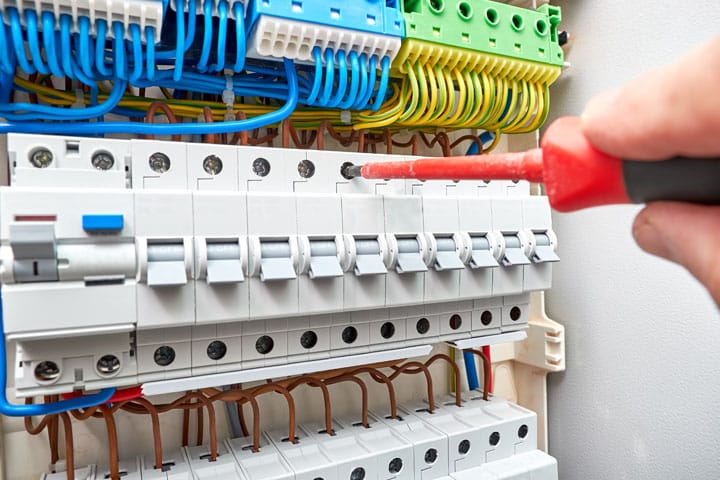
Open your switchboard and look for the breaker that has moved to the off or middle position. In most homes, each breaker controls a specific area or set of outlets. Knowing which circuit tripped helps narrow down the cause.
Unplug and Isolate Appliances
Switch off and unplug every appliance on the affected circuit. This includes items you might overlook, like a heater tucked behind furniture or a phone charger in a bedroom. One faulty appliance can trip the entire circuit.
Reset the Breaker Once
With everything unplugged, flip the breaker fully to off, then back to on. If it holds, reconnect appliances one at a time and wait a few minutes between each. The appliance that causes the trip is your problem. If the breaker trips again with nothing connected, the fault is in the wiring, and you need professional help.
Test Your Safety Switch
Your switchboard should have a safety switch (RCD) with a test button marked “T.” Press it. The switch should trip immediately. If it doesn’t, your safety switch needs testing or replacement. According to the NSW Government, a safety switch is designed to protect people from electric shock, while a circuit breaker protects wiring. You need both working correctly.

When a Tripping Breaker Becomes an Emergency
Not all tripping situations carry the same level of risk. This table helps you assess the urgency:
| Situation | Risk Level | What to Do |
| The breaker trips once after running too many appliances | Low | Reduce the load on the circuit. Spread appliances across multiple outlets. |
| Breaker trips repeatedly on the same circuit | Moderate | Unplug everything. Reset once. If it trips again, book an electrician within 24-48 hours. |
| Breaker trips instantly after reset, with nothing plugged in | High | Do not reset again. Call an emergency electrician immediately. |
| Burning smell, scorch marks, or warm outlets | Critical | Turn off the main switch at your switchboard. Call 000 if you see smoke. Then call an electrician. |
| The breaker trips and won’t reset at all | High | Leave the breaker off. This indicates a serious fault in the wiring or the breaker itself. |
| Multiple breakers trip at once during a storm | Moderate | Wait for the storm to pass. Reset breakers one at a time. If they keep tripping, call for help. |
Under AS/NZS 3000 (the Australian and New Zealand Wiring Rules), all electrical work must be carried out by a licensed electrician and tested for compliance. Attempting to repair wiring, replace a breaker, or modify your switchboard yourself is illegal in NSW and dangerous.
Why Circuit Breaker Problems Are More Common in Older Parramatta Homes
Repeated breaker trips are not random. They follow patterns tied to housing age, wiring type, and electrical demand. Several factors make homes across the Parramatta region more susceptible:
- Original wiring from the 1960s and 1970s: Many homes in Epping, Eastwood, and Carlingford were built during the postwar housing boom. These homes often still have original wiring with insulation that has become brittle and cracked over 50-plus years. Deteriorated insulation exposes conductors and creates short-circuit conditions.
- Outdated switchboards without safety switches: Older switchboards in suburbs like Denistone, Dundas Valley, and West Ryde often rely on ceramic fuses or early-generation circuit breakers. These systems lack modern RCD protection and may not trip quickly enough to prevent overheating. A switchboard upgrade brings the system up to current standards.
- Increasing electrical demand: Homes that were wired for a few lights and a radio now run air conditioners, electric cooktops, home offices, and EV chargers. According to the ABS 2021 Census, the City of Parramatta saw a total dwelling increase of over 20,900 between 2016 and 2021, reflecting rapid growth and higher electrical demand across the region.
- Ageing appliances in established homes: Older homes in Pennant Hills, Turramurra, and Melrose Park often have original hot water systems, rangehoods, and hardwired appliances that have deteriorated. These draw irregular current and can trip breakers intermittently. PowerHub Electrical often finds that replacing a single ageing appliance resolves what seemed like a complex wiring fault.
- Aluminium wiring in some 1970s builds: A small number of homes from this era used aluminium wiring, which expands and contracts more than copper. Over time, connections loosen and create resistance points that overheat. This is a known fire risk that requires professional assessment.
More: Signs Your Home Is at Risk of an Electrical Fire
How a Licensed Electrician Diagnoses a Tripping Breaker
When basic troubleshooting doesn’t reveal the cause, a qualified electrician uses specialised tools and a systematic process to find the fault. Here is what a thorough diagnosis involves:
Visual Inspection of the Switchboard
The electrician starts by examining the switchboard for obvious signs of damage. This includes burnt connections, melted insulation, discoloured wiring, and corrosion on breaker terminals. Older switchboards often reveal faults that are invisible from the outside of the panel.
Circuit-by-Circuit Load Testing
Each circuit is tested individually to measure how much current it draws under normal conditions. If a circuit draws more amperage than its breaker rating, the source of the overload is traced and resolved. This process identifies whether you need additional circuits or a full electrical repair.
Insulation Resistance Testing
A megger test measures the resistance of the wiring insulation on each circuit. Low resistance readings indicate degraded insulation, moisture ingress, or damaged conductors. This is one of the most reliable ways to find hidden faults causing intermittent tripping.
Thermal Imaging for Hidden Faults
Infrared cameras detect heat buildup behind walls, inside switchboards, and at connection points. Hot spots indicate high-resistance connections or overloaded wiring that could ignite.
After a recent switchboard inspection, the team received this feedback: “I couldn’t recommend Brian and his team more! Not only were the jobs completed in a very professional and clean way, but Brian was happy to answer all my questions beforehand so I could figure out what would be best, “Pascale Fricke. That thoroughness is what separates a proper diagnosis from guesswork.
All electrical work in NSW must be followed by a Certificate of Compliance for Electrical Work (CCEW), as required under the Gas and Electricity (Consumer Safety) Act 2017. Any electrician who doesn’t provide one after completing work is not meeting their legal obligations.
How to Prevent Your Circuit Breaker From Tripping
Most breaker trips are preventable with basic electrical maintenance and smart habits. These steps reduce the likelihood of repeated tripping:
- Spread appliances across multiple circuits: Avoid plugging high-draw appliances like kettles, toasters, and microwaves into the same circuit. If your home has limited circuits, talk to your electrician about adding dedicated circuits for the kitchen and laundry.
- Upgrade an outdated switchboard: If your switchboard still has ceramic fuses or breakers without RCD protection, it is overdue for an upgrade. A modern switchboard distributes power more safely and handles today’s electrical loads without tripping.
- Install safety switches on every circuit: In NSW, safety switches are required on power point circuits in new homes and rental properties. But many older homes only have partial coverage. A full electrical safety inspection will identify gaps in your RCD protection.
- Schedule regular electrical inspections: An inspection every three to five years catches deteriorating wiring, loose connections, and overloaded circuits before they become dangerous. This is especially important for homes older than 25 years.
- Replace ageing appliances: Old appliances with cracked cords, worn elements, or internal faults are a common trigger for breaker trips. Replacing a 20-year-old electric stove or hot water system can solve recurring trip issues.
- Avoid daisy-chaining power boards: Plugging one power board into another creates a fire risk and overloads the circuit. If you need more outlets, have additional power points installed by a qualified Parramatta electrician.

Areas We Service
PowerHub Electrical services homes and businesses across Parramatta and the greater western Sydney region, including Epping, Carlingford, Ryde, Eastwood, Beecroft, Dundas Valley, West Ryde, Marsfield, Macquarie Park, Pennant Hills, Denistone, Telopea, West Pennant Hills, Turramurra, and Melrose Park.
Book a Circuit Breaker Inspection Today
If your circuit breaker keeps tripping and you can’t find the cause, call PowerHub Electrical on 0400 332 331. Licensed electricians, same-day service, 24/7 emergency response, and a 15% pensioner discount on all work. $50 off your first service.
Frequently Asked Questions
Can a tripping circuit breaker start a house fire?
Yes. A breaker that trips repeatedly indicates an electrical fault such as a short circuit or overloaded wiring. If you keep resetting it without fixing the underlying cause, wiring can overheat and ignite materials inside walls.
Is it safe to keep resetting a circuit breaker that keeps tripping?
Resetting once to diagnose the issue is reasonable. Resetting it repeatedly without identifying the cause is dangerous. Each reset re-energises a potentially faulty circuit and increases the risk of fire or shock.
What is the difference between a safety switch and a circuit breaker?
A circuit breaker protects the wiring in your home from overloading and overheating. A safety switch (RCD) protects people from electric shock by detecting current leakage to earth. Homes in Parramatta and the surrounding suburbs need both for full protection.
Why does my circuit breaker trip at night?
Night-time tripping is often caused by appliances that cycle on automatically, such as fridges, hot water systems, or pool pumps. Deteriorated wiring can also become more prone to faults as temperatures drop and insulation contracts overnight.
How do I know if my circuit breaker is faulty?
Signs of a faulty breaker include tripping under light load, refusing to stay in the on position, visible scorch marks, or a burning smell at the switchboard. A qualified Epping electrician can test the breaker with calibrated equipment to confirm whether it needs replacing.
When should I call an electrician for a tripping breaker?
Call immediately if you notice a burning smell, scorch marks, warm outlets, or if the breaker trips with nothing plugged in. For intermittent trips, book an inspection within 48 hours. In NSW, only a licensed electrician can legally carry out electrical wiring work.